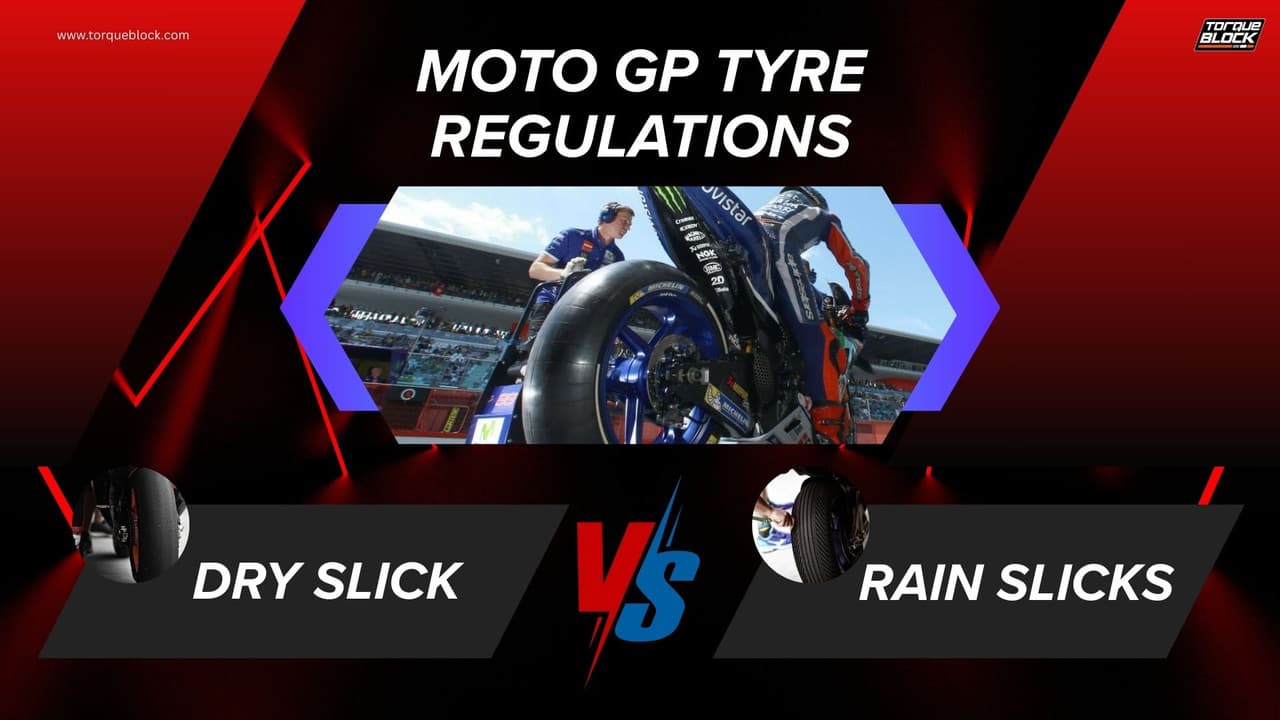
1.Detailed Breakdown of MotoGP Tyre Regulations.
Slick Tyres
Riders are allocated a total of 22 slick tyres, including 10 front and 12 rear slicks.Rain Tyres
There are also 13 rain tyres allocated, with 6 front and 7 rear rain tyres.Qualifying Bonuses
Riders who participate in both Q1 and Q2 qualifying sessions are granted one additional front and one additional rear slick tyre.Wet Qualifying
If both Q1 and Q2 are declared wet, the extra tyres allocated will be rain tyres (of the rider's preferred specification).Tyre Pressure Monitoring
MotoGP has a Tyre Pressure Monitoring System (TPMS) that ensures riders maintain a minimum tyre pressure throughout the race. Riders must maintain a minimum pressure for a certain percentage of laps, depending on the race distance.Tyre Changes
Tyre changes on the grid are permitted, but changing the type of tyre (from slick to rain or vice versa) in the pit lane will result in a penalty.Michelin's Role
Michelin is the exclusive tyre supplier for MotoGP until the end of the 2026 season, after which Pirelli will take over.Drona Community
While the Drona Community is not officially involved in setting the tyre regulations, they often provide commentary and analysis of the tyre strategies used by different riders and teams during Grand Prix weekends. Key Points to Remember.MotoGP™ rules on tyre specifications.
2. Find out Apex - How will your tyre perform on cornering?
The "apex" in racing refers to the innermost point of a corner, where a driver is closest to the inside of the turn, aiming to minimize the arc of the bike's path. When a tyre hits the apex, it experiences the most lateral force, directly impacting cornering performance. Understanding how tyres behave at the apex is crucial for achieving optimal speed and control through corners.Here's how your tyre's performance at the apex affects cornering?
For MotoGP, tyre control is determined by the Fédération Internationale de Motocyclisme (FIM) and governs the quantity and composition of tyres that a rider may employ in a Grand Prix weekend. The regulations accommodate for slick and rain tyres, together with additional tyre allocation to those riders who will be starting from Q1 and Q2. Riders would generally fit on brand new, soft tyres if they are expecting a quick practice lap and a fast qualifying stint,While on race day, they have to decide which specification tyre will complement their riding habits and strategy well over the distance. Under wet, mixed or wet-drying conditions, the MotoGP™ championship riders have to make a choice about using rain tyres or slicks, which is always a risk since rain tyres offer greater stability in wet conditions, but slicks enable the rider to lap significantly faster. They are established and revised by the Grand Prix Commission, which includes members of the FIM, Dorna Sports (organiser and rights holder of MotoGP™), IRTA (International Road Racing Teams Association) and the MSMA (Motorcycle Sport Manufacturers Association).Grip and Cornering Force
Since the tyre is moving around the corner, it goes from being subjected mainly to longitudinal forces (braking and acceleration) to more and more being subjected to lateral forces (cornering). The point of greatest lateral force is at the apex. A well-gripping tyre at the apex will enable the bike to accelerate and corner quicker.Tyre Wear and Degradation
The peak is where a tyre goes through maximum stress and wear. tyres with better cornering capability usually have tread patterns that maximize grip and stability in cornering.Best Racing Line
The point of highest bank is also the most important factor in establishing the best racing line around a corner. The objective is to reach the apex at the correct moment, which is where the bike's arc is at its minimum and can easily transition into the exit, enabling one to have an increase in exit speed.Tyre Pressure and Width
Tyre pressure and width also have an effect on cornering capability. more pressure and wider tyres provide greater contact between the tyre and road, enabling more cornering force and grip.Tread Design
The tread pattern of a tyre plays a major role in its cornering capability. tyres that are optimized for better cornering have tread patterns with bigger shoulder blocks, sipes, and grooves to ensure grip and stability in turns.3. Slicks and Rain Slicks(Asymmetrical Slicks / Semi slicks).
Slick tyres are smooth tread racing tyres for dry surfaces, while rain tyres have grooves for wet surfaces. "Asymmetrical slicks" is not a description of a particular racing tyre. It's probably the name referring to the design of semi-slick tyres, which combine the qualities of slick and normal tyres.Slick tyres
Design Slick tyres have a smooth tread, meaning they lack grooves or other tread patterns. Purpose They are used in racing for dry conditions to maximize grip by providing a large contact patch with the road. Limitations Due to the lack of grooves, they are not suitable for wet conditions and can lead to hydroplaning.Rain tyres
Design Rain tyres have grooves or channels that help to displace water and prevent hydroplaning. Purpose They are designed for use in wet or rainy conditions to maintain grip and control. Limitations They may not provide the same level of grip in dry conditions compared to slicks.Semi-Slick tyres
Design Semi-slicks combine the characteristics of both slick and regular tyres, often with minimal tread cuts. Purpose They offer a compromise between the dry grip of slicks and the wet performance of rain tyres, potentially allowing for use in both dry and slightly damp conditions. Limitations They may not be as effective in very wet conditions as full rain tyres, and they may not provide the same level of dry grip as slicks.4. When it rains, how does the heat cycle and tyre pressure affect the race? Case study on Crash Incident - 2022 Indonesian GP (Jorge Martin)/ 2025 Alex Marquez French Gp.
During damp racing conditions, heat cycling and tyre pressure control are of paramount importance. Wet weather reduces grip considerably, and correct tyre pressure is necessary to ensure traction as well as the prevention of hydroplaning. Heat cycling, which refers to the cyclical heating and cooling of tyres, impacts their performance and causes them to degrade.Tyre Pressure in Wet Conditions
Increased Cold Pressure
Wet racing usually demands greater cold tyre pressures (pressure at the beginning of the race) than dry weather. The reason is that tyres tend to be less efficient in heat dissipation in wet weather, so greater pressures will keep the tyres with a larger contact patch and adhesion.Lower Running Pressure
While higher cold pressures are used initially, the overall pressure during the race will typically be lower than dry conditions. This is because wet conditions generate less friction, and the tyres don't need to be inflated as much.Hydroplaning
Hydroplaning occurs when tyres lose contact with the road surface due to a layer of water. Proper tyre pressure is crucial to avoid hydroplaning, as underinflated tyres are more susceptible to this issue.Heat Cycling in Wet Conditions.
Reduced Heat Build-up
Wet racing conditions typically result in less heat buildup in the tyres compared to dry conditions. This is because water helps dissipate heat.Tyre Degradation
While wet conditions may reduce heat buildup, they can still cause tyre degradation over time. Water can affect the rubber's chemical structure, leading to reduced grip and performance.Heat Cycling Considerations
In wet racing, it's important to manage heat cycling by avoiding excessive hard braking and accelerating, as these actions can generate heat in the tyres. In summary, wet racing requires a careful balance between tyre pressure and heat management. Higher cold pressures and lower running pressures are used to maximize grip, while avoiding excessive heat buildup and tyre degradation is essential for a successful race.Similarity Between the Crashes
Yes, both crashes happened due to a similar root cause — tyre-related grip loss in changing weather or track conditions.Here’s what was common
2022 Indonesian GP – Jorge Martin Crash.
2025 French GP – Alex Marquez Crash.
5.Why Mid-Race Tyre Change Is Important?
1.Crucial takeaway
In flag-to-flag races, the ability and decision to change tyres based on the evolving track condition is often what separates a podium finish from a crash.Here’s why